.png)
Gemma Martin
Ecosystem Builder

Lorem ipsum dolor sit amet, consectetur adipiscing elit volutpat potenti laoreet risus egestas et lorem leo dui.
Human health is more than diet and exercise; it’s the harmony between people, planet, and prosperity. True health arises when ecological and economic systems thrive together. Yet the current food system is fragmented, driven by silos that separate health from sustainability, and people from planet. To truly empower human health, businesses must look beyond profit and product. They must connect sectors, align intentions, and scale impact across borders. By undressing assumptions and daring to act boldly, we can turn complexity into connection, and fuel a regenerative food future that works for everyone.
The World Health Organisation defines health as “a state of complete physical, mental and social well-being and not merely the absence of disease or infirmity.” Nutrition plays a central role in achieving this, yet food is more than fuel; it is pleasure, culture, and connection. True human vitality depends on food that is not only nutritious, but also accessible, affordable, and enjoyable. To support diverse needs and lived realities, we must recognise that one size does not fit all. Gut health and personalised nutrition are essential to restoring balance, enabling food to support individual wellbeing while strengthening our collective health potential.
Healthy people depend on healthy ecosystems. Thriving soils, clean water, and biodiversity enable diverse, nutritious crops and accessible, sustainable produce. Clean-label foods and diversified proteins are part of a regenerative approach that protects both people and planet. A degraded environment limits access to nutrition. Prioritising ecological balance is not optional; it is the foundation of human health and a prerequisite for any sustainable, future-fit food system.
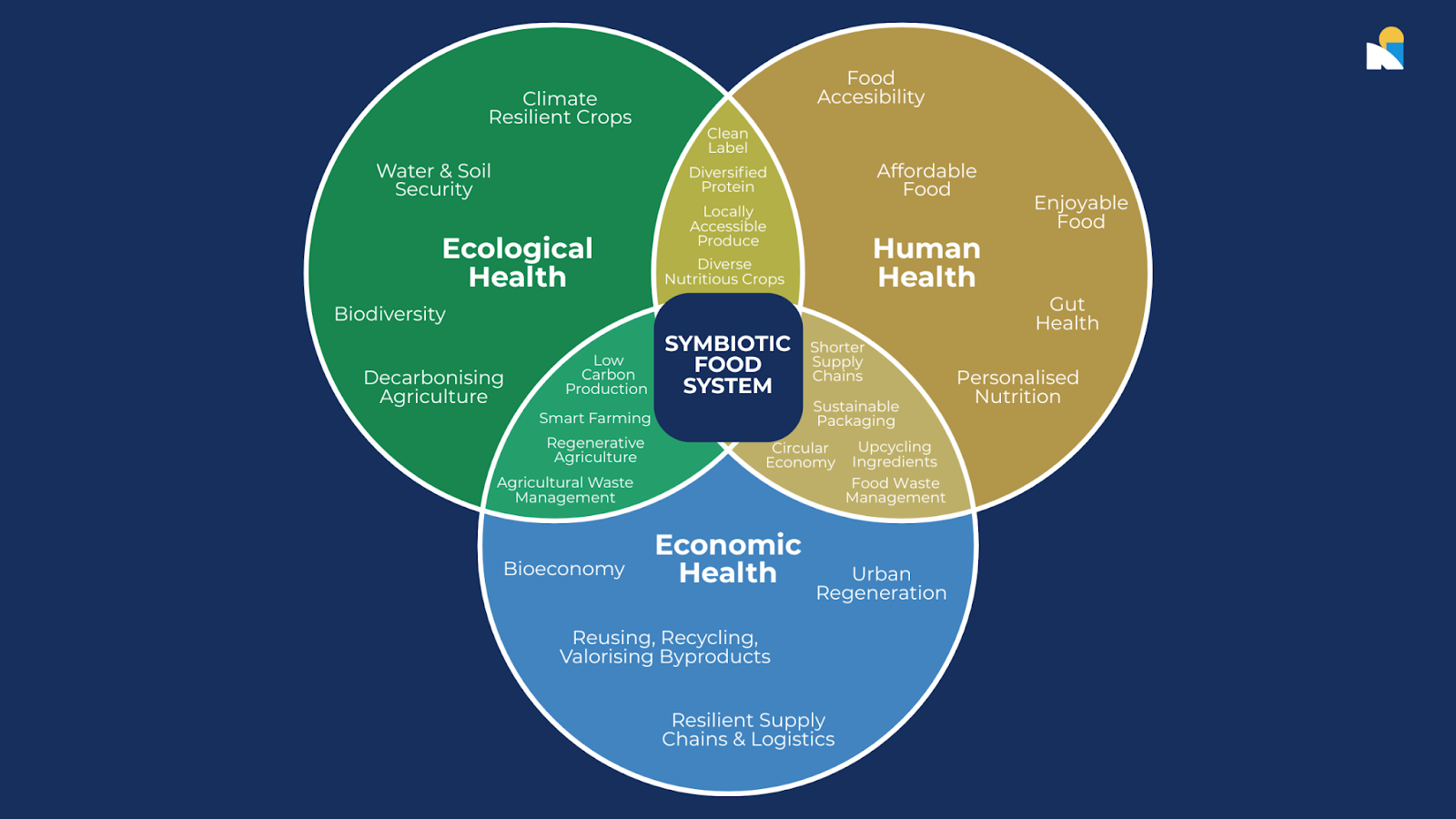
In order to have access to good healthcare as well as nutritious food, our society needs to be in good economic health. When economies fail, communities face challenges such as obesity, over-consumption of ultra-processed foods and a lack of access to affordable nutritious food. Shorter, more transparent supply chains, sustainable packaging, food waste management, and upcycling ingredients strengthen both local economies and human wellbeing. These are not efficiency measures alone, they represent care in action. They build circular economies where value circulates instead of being extracted, ensuring that prosperity is shared rather than hoarded.
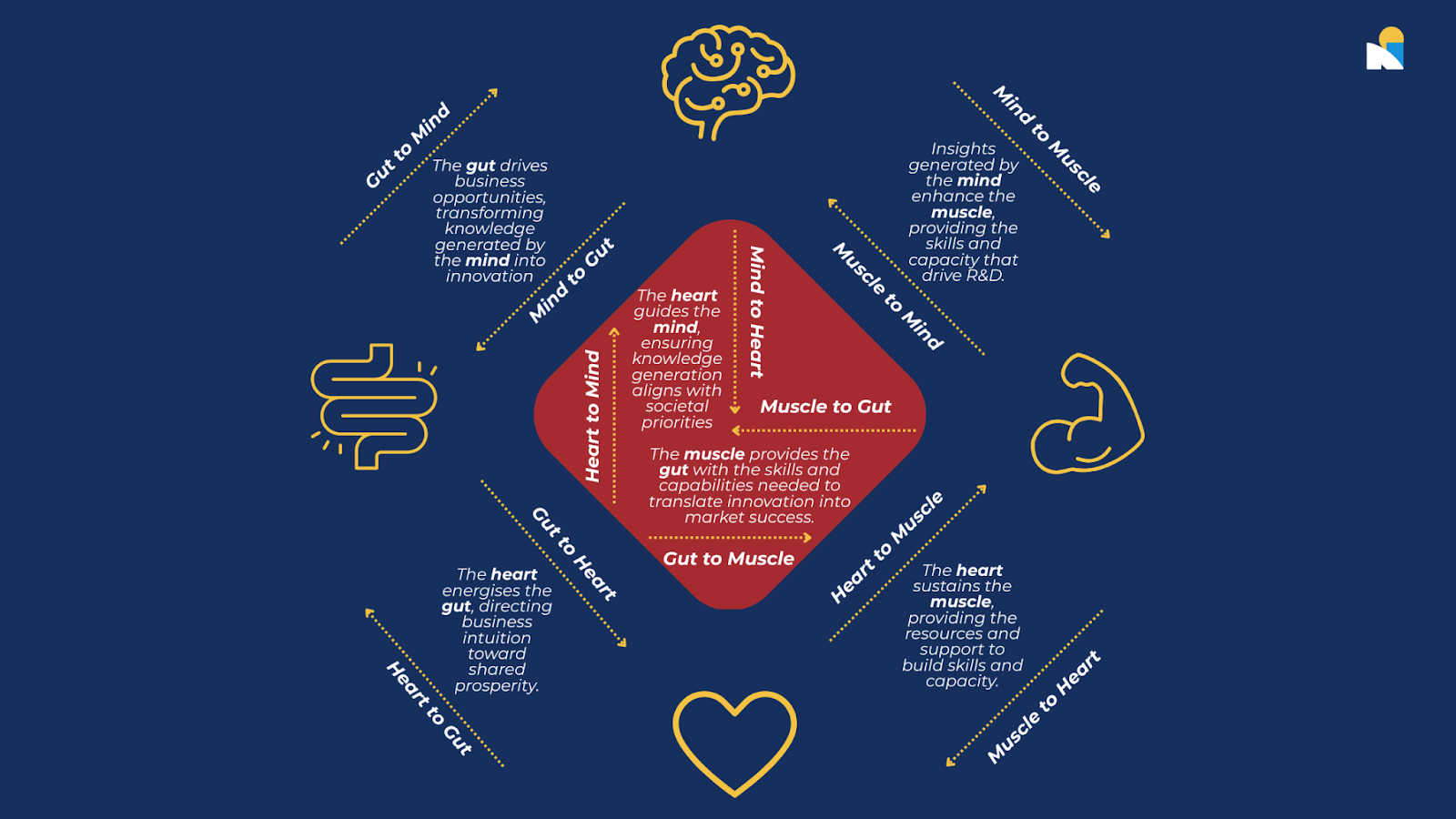
In the symbiotic food system, businesses act as the Gut, the instinctive force that transforms knowledge into innovation and vision into tangible change. They are the system’s engine: sensing opportunities, digesting insights from research, and turning them into products, services, and strategies that shape what people eat and how they live.
But business cannot operate in isolation. For innovation to truly serve human health, it must flow freely across the food system—connecting research and knowledge, the Mind behind the system; the Muscle that strengthens it through skills and capabilities; and the Heart of the food system: governance and policy. This interconnected model ensures that scientific discovery informs business practice, that workers are equipped to deliver, and that policy enables, rather than constrains, transformation.
As the Gut, businesses hold the power to make food accessible, affordable, nutritious, and enjoyable while fostering ecological balance and economic inclusion. Every business decision, from sourcing ingredients to designing packaging, becomes an act that either strengthens or weakens the collective body of the food system.
To lead this transformation, businesses must act with boldness and empathy. They must break silos, build trust, and collaborate across sectors, turning innovation into connection and opportunity into shared prosperity. When the Gut thrives in harmony with the Mind, Muscle, and Heart, the entire food system grows; nourishing people, planet, and progress.
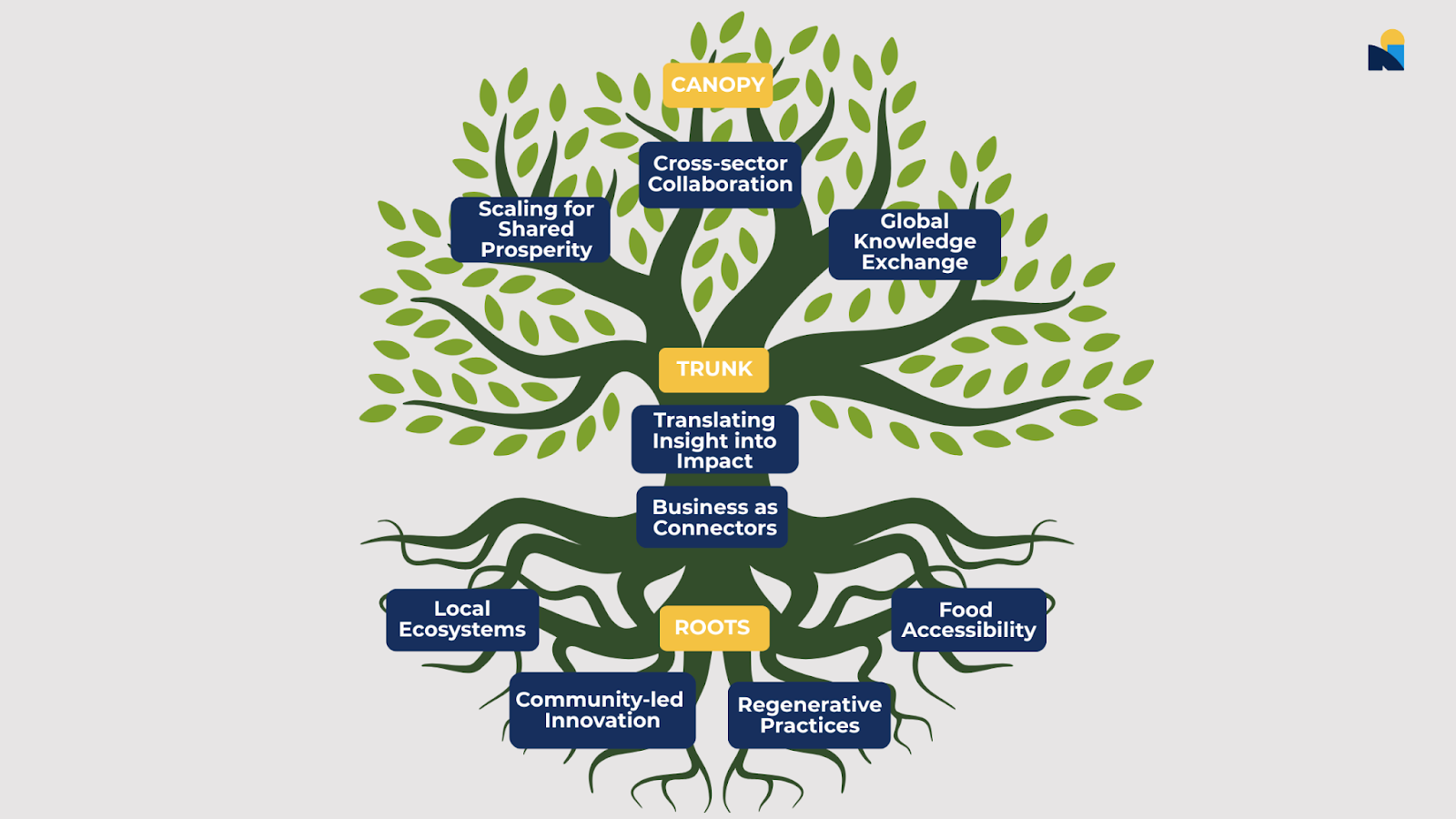
To empower human health, businesses must move beyond incremental improvements and embrace systemic innovation, the kind that breaks silos, bridges sectors, and connects local action with global learning. Much like a tree, transformation takes root locally and grows globally. Strong local roots , from regenerative farming to community-based food access, nourish the wider ecosystem. But for those roots to bear fruit, businesses must act as the trunk: translating local insights into global collaboration, scaling impact across borders and industries.
The first step is to break silos. Health, sustainability, and profitability are often treated as separate agendas, yet they are deeply intertwined. Businesses can foster collaboration between farmers, scientists, technologists, and policymakers to co-create solutions that regenerate the food system. True innovation happens in relationships; through open dialogue, trust, and shared accountability.
Next, businesses must think local and connect glocal. Local ecosystems hold the wisdom and context to design solutions that work, from regenerative farming practices to community-based food access programmes. Yet scaling these requires global collaboration. By linking local innovation to international networks, businesses can share knowledge, adapt solutions, and amplify impact across regions.
Finally, businesses must scale for impact. This means rethinking value creation, moving from extractive models towards circular ones where waste is repurposed, packaging is sustainable, and by-products gain new life. It’s about cultivating communities and partnerships that prioritise long-term vitality over short-term gain.
At Naked Innovations, we call this approach undressing the food system, stripping away assumptions and daring to be transparent, bold, and human. When businesses act with curiosity and courage, they not only grow; they become the driving force of a healthier, more connected, and regenerative food future.